Friday, March 22, 2013

Review: Gravity's Rainbow

Gravity's Rainbow Gravity's Rainbow by Thomas Pynchon
My rating: 4 of 5 stars

Gravity's Rainbow is one of those books that I'd have to reread again to really understand it, except I'm not entirely sure if I want to reread it again. Or at least not anytime soon. It's hard enough to try and make sense of what's happening on each page, let alone what it actually means in the big picture. For many good chunks of the book I felt like I was reading words and sentences that looked like they should have made sense but they didn't. And this would still hold true after rereading the same page several times. Sometimes the point of view just changes on you mid-para-sentence and all of a sudden you have no idea what's going on anymore.

Luckily it becomes a bit easier to follow once you get past the first quarter (if you're that patient), when the action decides to focus around [arguably] the main character, Slothrop. Even then the narrative digressions and obscure references (which require their own companion encyclopedia) are still hard to follow sometimes. But I have to admit, those few moments where I did understand what was going on, it was like having a light bulb turn on in my head and realizing, "woah, this novel is actually kind of brilliant." In its own way.

I guess as another way to put it, I found that there were a lot of seemingly nonsensical moments that actually somehow... made sense. Ironically. Kind of similar to how when you're daydreaming you end up thinking a lot of nonsensical or irrational thoughts that make sense to you at the time and then later on you're wondering what on earth you were thinking. Only this was essentially the reverse process of that.

And even some of the really random episodes- like the one about the extinction of the dodos, or the history of Byron the light bulb, or the dream sequence with the attacking giant adenoid, or the technical jargon about Poisson distributions and an aerospace engineering equation and the chemical properties of a molecule that somehow triggers hallucinations, or the random argument about the semantic use of the term "ass-backwards" where "ass" might be a exaggerated modifier except that "backwards-ass" would make more sense in that case and so on- were really entertaining, even if I couldn't quite figure out why the author was writing about them.

But yeah, I might come back to this novel someday... If I find the time and patience to.

Review: The Name of the Wind

The Name of the Wind The Name of the Wind by Patrick Rothfuss
My rating: 2 of 5 stars

So I'm mainly editing this now cause Rothfuss recently got announced as a stretch goal/likely additional writer for a game I'm really looking forward to (Torment: Tides of Numenera) and as my rating would suggest I kinda have mixed feelings about it. Well, I'm looking forward to seeing how he contributes to it, anyway.

But back to this book. This is mostly going off memory right now, but it wasn't actually that bad of a book (although I'm kinda glad goodreads suggests two stars = "it was ok" rather than bad). It's actually quite fun to read, and I'd recommend it if you're looking into fantasy series to pick up and have an interest in stories told by storytellers about stories and being semi-meta about it. That kind of stuff actually would appeal to me too. It's just...

Kvothe is too much of a Mary Sue. I'm probably repeating what dozens of other reviewers have already said, but I pretty much felt the same way about it by the end of the book. I don't know if it was the narrator or the setting or the story or all of the above but it felt like everyone in the universe of this book loves to heap praises on how mysterious Kvothe is, how heroic Kvothe is, how much of a fantastic child prodigy with a tragic childhood and future Kvothe is (almost like Batman except Batman's cooler, no contest). Even though he clearly does make mistakes sometimes and isn't perfect by any means, the way his story is framed, it all just feels too convenient for him. Even the times when he's just a poor kid wandering the streets looking for his next meal, and you're just waiting for when he'll rise above it all and become the hero he's bound to become- and then it happens just as expected. He gets his next big break and it's all upwards from there.

By the end of the book, I kinda felt like the fascination and intrigue about the guy just wore off on me, so I couldn't really take his present misery as seriously anymore. The writing and prose itself is great and all, but Kvothe as a character doesn't really jive with me the same way, so I don't feel as inclined towards reading more about him even though it's supposed to be a trilogy. That said, considering that Kvothe himself is the narrator, I think the later installments would benefit from further exploring the idea of his story being told to us as unreliable. I think it would make for a more substantial read.

With that said, I don't entirely doubt Rothfuss's abilities as a writer, so I guess I'll still look forward to reading his future works, including his contribution to Torment. Just hoping it gets better from here.

Review: Dune Messiah

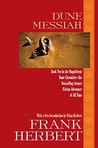
Dune Messiah Dune Messiah by Frank Herbert
My rating: 3 of 5 stars

Seeing as how this novel is the sequel to Dune, I have to say I was slightly disappointed- I don't think it stands alone as well in comparison. Technically yes, the messages are different; however, Dune ended in such a way that I felt satisfied enough to not read any further if more books didn't exist, but at the same time I'd still be open to reading further. With this installment, I don't really feel satisfied enough in the same way... which seems to be more of a reason to read the next book, as even the foreword admits (if I recall correctly anyway). If anything this book feels more like a setup for the next one (Children of Dune), which I guess I should read next anyway. Dune just acquired a typical trilogy structure.

The majority of the book consists of a lot of talking, plotting, discussing, planning behind the scenes and so on. There's a number of factions in the Dune universe that all have their own agendas going on here, which results in a lot of conversations between folks where one party is second guessing what the other person is saying or questioning their motivations or trying to anticipate what they might do or say next, which I think is fairly typical for a politically motivated sci-fi/fantasy story. The third person narrator tends to jump back and forth between pretty much everyone in every conversation, which allows us to have more objective insight into the conflict itself, covering a broad array of issues like the aftereffects of the rise of political/religious movements, and the logistical and moral issues their leaders must face. It's definitely material worth stepping back and mulling over for a bit... even though at the end of the day, it technically is mostly a fat load of talking.

Granted, some action does happen in this book, more towards the end, but at the same time, I had a hard time appreciating it as real events, the kind that stand out in a novel and leave an imprint in my imagination and remind me why I'm reading novels in the first place. It just felt more like, oh, here's some stuff that happens and some conflict and some setup for the next big thing that we can vaguely hint at for now. I mean yes, what happens to Paul in this book is probably about as significant and important to the message and scope of the series as what happened in the original book, but it doesn't feel complete or striking without knowing the resolution that (I'm hoping) comes in the next one. Part of me feels like it'd have been better if they'd just combined this book with Children of Dune and made it into two halves or the first third of THE sequel to Dune, like they apparently did with the TV series anyway.

That said, I appreciated the conversations that did happen. It was fun getting into the minds of the individual characters and sharing in their confusion and wonderment about their future and the uncertainty it brings... ironically, even though Paul (and perhaps Alia and some others) is supposed to possess prescient knowledge, it doesn't resolve everything as simply as we would like.

Review: 1Q84

1Q84 1Q84 by Haruki Murakami
My rating: 3 of 5 stars

This is the third Murakami book I've read (after Wind-Up Bird and Kafka, both of which I loved), but I feel like the Murakami spell is starting to wear off on me now. It's still got the usual stuff you'd expect from him- cats, woman's ears, lonely people, kinky sex, and stories about the war in Manchuria- but somewhere down the line it starts to fizzle out.

The first half of the book felt fairly engaging, and there were a few chapters that really struck out to me, but by the last third of the book I was just wondering when it would end. I mean, Murakami's writing does tend to go on and on and on and- well, it's written in such a way that I don't mind it as much; you're just going along for the ride and seeing where it takes you. But even this was a bit much for me.

Technically, I guess it makes sense considering that it is longer than the former two books... but really, I think it could've been a lot stronger as a novel had it been shorter and more concise this time. There really wasn't enough going on to justify how long this book is. After a while you kinda get tired about reading about the unresolved tensions of lonely people for over a thousand pages- or maybe that's just because they've been handled better before.

That said, my favorite chapter that comes to mind right now is the one with the story about the town of cats (which can be found online as an excerpt that was printed in the New Yorker).