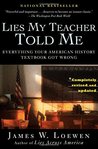
 Lies My Teacher Told Me : Everything Your American History Textbook Got Wrong by James W. Loewen
My rating: 4 of 5 stars
I feel like I read this a decade late again, but it's still a worthwhile read for adults, particularly anyone involved in education although the subject is specifically aimed at high school history teachers. The title is technically a slight misnomer, as the book is really about the lies that high school history textbooks teach us, with history teachers being complicit by proxy whenever they adhere to a textbook without critically assessing it themselves or giving students the opportunity to do so.
Each chapter covers a different topic from American history that has been misrepresented by history textbooks, ranging from the heroification of people like Helen Keller, Woodrow Wilson, and Columbus, to (in the second edition of this book) 9/11 and the Iraq War and why these texts are usually found lacking when it comes to the more recent decades (as it turns out, simply saying it's too recent to study isn't really that solid of an excuse). The other half of the discussion itself is devoted to what these textbooks actually say and then attempting to analyze why they fail to properly represent the topic at hand, which ends up amounting to a myriad of possible explanations.
A lot of the conclusions reached aren't really that surprising or novel to be honest if you've read any kind of historical material (nonfiction, primary/secondary sources, studied history in college, etc.) outside of high school textbooks or in one way or another have managed to keep informed on these subjects post high school, but it's well worth having articulated and compiled here, and I would definitely recommend this for high schoolers looking to have their eyes opened to how history really works. If I still had my high school textbook I'd have wanted to make comparisons after reading this book myself... I wonder how much it'd have changed my understanding of things then.
Loewen's discussion naturally takes on a political, rather liberal bent regarding how to deal with the issues he sees in our education system and American society itself, where the obscuration of truth and censoring of alternative viewpoints is often pushed in support of nationalism and reinforcing the status quo. I personally happen to agree with his views in general, but conservative readers will probably take more issue with them and may outright disagree with him on certain points. I do not feel that this invalidates the overall discussion at hand though, as taking a critical perspective on our history is important in any respect and this book does much to try to encourage that in its readers.
The big takeaway here is that history is not set in stone, just like any other academic subject or source of knowledge we use in this world. It often is taught at a younger age as a mere collection of boring facts and names and dates to be memorized, which trivializes it in the eyes of young people and prevents them from actually being able to apply it to our understanding of current and future events when that ought to be real reason we study it in the first place. It's jarring considering that in other subjects like the sciences, we don't really have a problem acknowledging that we don't know everything and that our current knowledge is malleable and subject to change in the future... and yet we often assume that history itself is static and unchanging, when in reality our understanding and interpretation of it changes with time itself.
If anything, this book got my mind running again and reminded me why I love learning about history. Good stuff.

No comments:
Post a Comment