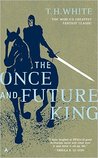
 The Once and Future King by T.H. White
My rating: 4 of 5 stars
So I originally had to read the first half of this book for school years ago, but I never actually got around to finishing the latter half till now. Incidentally, I enjoyed the second half of this book way more than the first half this time around.
The Once and Future King is a modern (well, WWII-modern) era retelling of the legends of King Arthur and his knights of the round table, largely based off of the medieval era work Le Morte d’Arthur by Sir Thomas Malory (supposedly, anyway since no one seems to know who “Thomas Malory” actually is). It’s pretty noticeable, actually, given the number of times the narrator in this book goes, “I could talk about this story but you’d be better off hearing it from Sir Malory."
Which is to say that despite the apparent premise as a general overview of the life of King Arthur- and in fact people will often mark this book as THE go-to for an introduction to him- it’s a rather specialized work, focusing instead on the philosophical aspects of the Arthurian legend, and hence it tends to neglect other stories that might not contribute as much toward that end. The book, particularly the first (The Sword in the Stone: the happy-go-lucky source for the Disney children’s movie you may be familiar with, which in retrospect wasn’t all that happy) and last part (The Candle in the Wind), comes across almost as a treatise on leadership and its complexities, and in particular how the ideals and reforms that Arthur brings about with his reign, the age of chivalry, also ironically contribute to his own downfall.
I always sort of took it for granted that the legend of King Arthur was a tragedy just because… well, bad stuff happens to good people sometimes and tragedies are more interesting than happily-ever-after stories. But this book really homes in just exactly why his kingdom went downhill and how inevitably tragic it was. It’s pretty depressing to think about, but it makes sense. Arthur’s a good man at heart, but good and noble intentions don’t always make for good leadership if you aren’t willing to make serious sacrifices for your ideals from the get-go- and well okay, that only addresses just ONE of his many issues (in fact he ends up making many sacrifices, but to what avail is debatable). The story forces you to realize the limits of authority and the difficult choices that leaders are faced with on a continual basis, and just how hard it is to actually be an effective ruler when the people you have to rule over are just so damn flawed and frustrating.
A number of chapters from this book end up becoming rather abstract on that note- taking you out of the narrative to meditate on the underlying philosophy that White’s concerned with, and it can feel almost preachy at times when all you really care about is what will happen next. But the text even in these moments is still worth examining, as White’s concerns are more relevant to the present-day than one may realize.
I regret not finishing this book the first time around. While it seemed easy enough to look at all of Wart’s different animal adventures in The Sword and the Stone and conclude that obviously, the geese did things right (unless you supported the ants, you dirty commie), it’s another thing to actually see Arthur’s response to his lessons carry out into his lifelong occupation and to learn where it works and where it doesn't.
This holds even in the third part, which disproportionately concentrates on the decades-long scandalous though perhaps not-quite-steamy-enough affair of Lancelot and Guinevere/“Jenny”- which while not uninteresting or even irrelevant in itself (read: I was obsessed), did feel a bit jarring compared to the more Arthur-centric focus of the rest of TOFK. You still get glimpses of Arthur’s role throughout it and his continuously evolving struggle, as seen in the Quest for the Holy Grail and its actual purpose and consequences. And the Ill-Made Knight himself encapsulates the central conflict of the novel pretty well.
But yeah, Lancelot is also kinda pitiful and Guinevere is insufferable and Gawaine is stubborn and Mordred and Agravaine are insane and Galahad is amusingly a snob and Percival doesn't really do much and Merlin is the best unfortunate backwards-time-traveling mentor ever- at the end of the day, it was just plain fun to finally meet all these characters I’d heard of but never really knew that well or understood and get a glimpse into the wider world of Arthurian mythology. The Once and Future King may have been just White’s politically infused reinterpretation of the story of King Arthur in response to the political landscape he witnessed in the 20th century, but it’s also an promising example of what can be accomplished with these kinds of interpretations. It’s both entertaining and insightful.

No comments:
Post a Comment