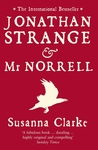
 Jonathan Strange & Mr Norrell by Susanna Clarke
My rating: 5 of 5 stars
I feel like I woke up in some alternate universe where Dickens and Austen had a precocious love child who decided to reinvent Harry Potter and somehow wound up making it nowhere near as contrived as Pride and Prejudice and Zombies. This is actually one of the most original fantasy novels I've ever read (...of the few I've gotten around to, anyway), even though the topics- magicians, early 19th century British society- aren't exactly original in themselves; even their combination, a what-if magic existed in the history of Great Britain, could be likened to an adult Harry Potter as some publications have put it. But it feels like so much more than that.
The first thing that struck me while reading this book was the sense of wonder it arouses. The writing style, inspired by the likes of novelists like Austen and Dickens, contributes a lot to this: each chapter progressively introduces the reader to a new or different aspect of the universe at large, in such a tone that you never really know who or what to expect next. In spite of what the title may suggest, there's actually a rather large and significant primary cast combined with a set of intertwining plotlines just as in the old 19th century novels, as well as a bunch of almost-encyclopedic footnotes used for exposition where there isn't room in the main story. In the case of the latter, it flows a lot better than forcibly integrating them into the plot considering how seemingly expansive the backstory is- both fictional and historical. You can also tell that the story is well-researched in its historical context, calling upon events like the battle of Waterloo and historical figures including mad King George III, Napoleon, Duke Wellington, Lord Byron, and so on.
I've heard it argued recently (by the likes of MrBtongue and more implicitly in other fantasy book reviews) that magic as a concept is done best when it is kept unknowable and mysterious, because that essentially is what defines it in the first place. In that respect, JS&MN handles this pretty well; magic in the series is valued for its utility as a problem solving tool, but at the same time it never is really fully understood even by the magicians themselves, who spend much of their time trying to rediscover and reinvent spells that have been lost in England for centuries. (It feels odd to admit, but it reminds me a lot of the experience of learning how to program... that sense of awe you experience when you start to realize how much you're capable of and how much you still don't know.) Whenever magic does show up, it always feels otherworldly and fantastic and never to the point of common convenience. And yet in spite of all of this, it somehow integrates surprisingly well with the story's historical setting. It plays to one of the book's major strengths how jarringly good it is at juggling commentary on 19th century social conventions on one hand and then inserting crazy fantastical magical shenanigans on the other within the same scene.
All of this broadens the scope of the story, which helps justify its length (and to be honest I was ready to read another several hundred pages by the time it ended). That said, given the pacing and number of pages, it probably isn't for everyone, and if you don't have the patience for the gradual expository writing style, the plot can seem to drag for a while. But it's nowhere near as bad as the ASOIAF/Game of Thrones series though, and in that respect I found it incredibly refreshing. Nothing about the plot feels overwritten or unnecessary in comparison; on the contrary, after finishing the book, a lot of the earlier chapters feel more intentional in retrospect, for their foreshadowing and development of the world. Honestly, it's best to enjoy the journey and experience of it while you can early on, because later on those last few hundred pages can zip by fast as events start to ramp up.
One other element that surprised me was how... misleading the book summary was, or at least to me. That's not to say that the description listed on the back cover and here on goodreads is inaccurate, but rather that the expectations I had set up for both Jonathan Strange and Mr. Norrell as well as how the plot would progress were totally different from what it ended up being, which to be frank was better than anything I could have imagined. The heroes and villains in this story are not who you would expect them to be, if you could even call them heroes and villains. And I'll leave it at that.
(For the spelling nazis among us, the randomly old-fashioned spelling choices for some words like "chuse," "sopha," "surprize," "shewed," and so on can be a bit distracting... but I got used to it after a while.)
To summarize, refreshingly original and well-written, and a great example of how to take inspiration from other sources history and fantasy-based without overtly plagiarizing or overdoing them. That said, I've been realizing over the years that I'm a sucker for the Dickensian style of writing and plot exposition when it's done well with even decent characters (for the record, I couldn't stand most of the cast of Great Expectations), and this novel was no exception; I was quite enthralled the entire way through for it. Bravo.

No comments:
Post a Comment